



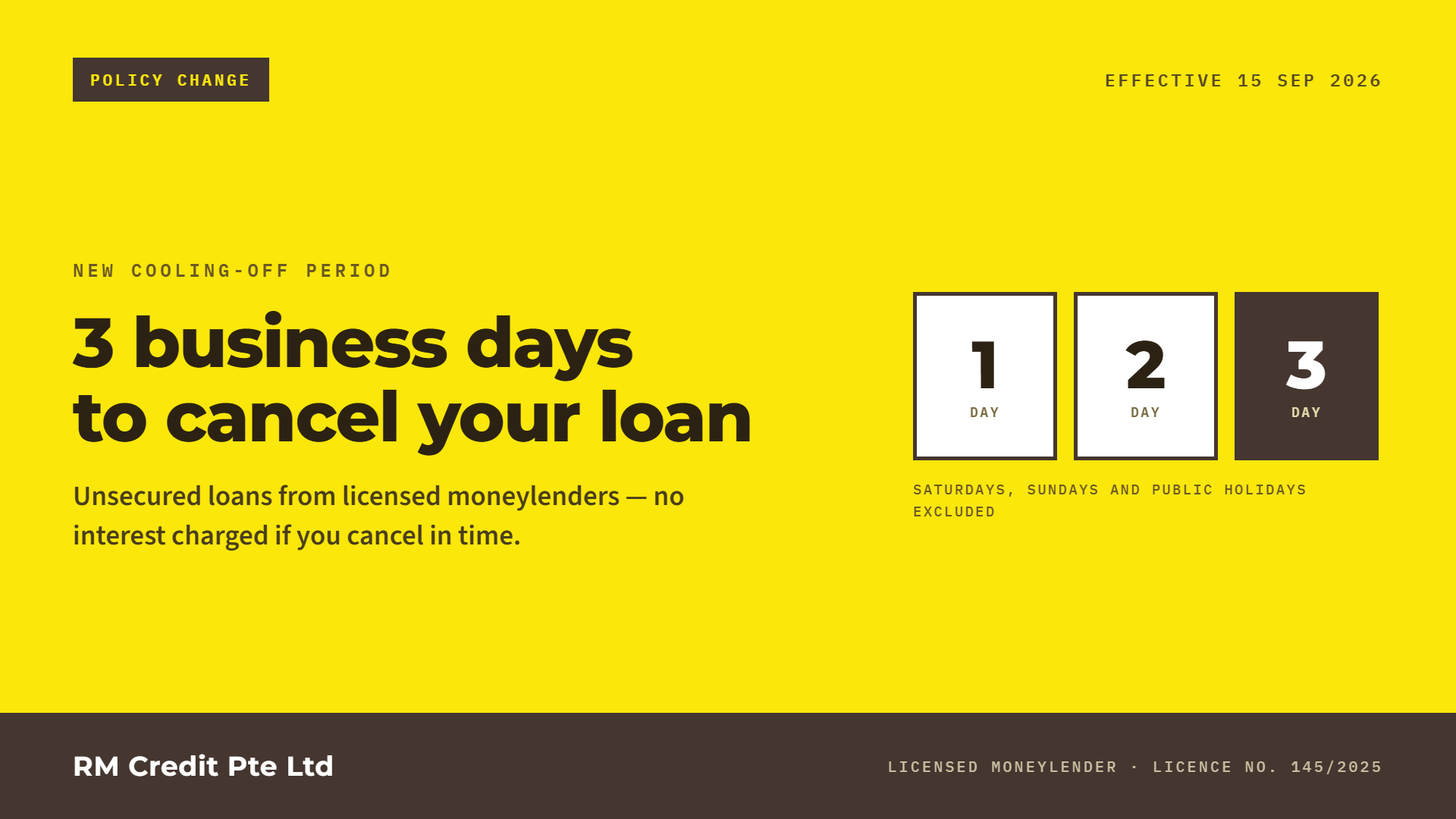
Stand-first: If you take an unsecured loan from a licensed moneylender in Singapore, you now have three business days to change your mind — and canceling within that window no longer costs you any interest.
What has changed
The Ministry of Law (MinLaw) announced on 31 August 2026 that a mandatory cooling-off period would apply to loans from licensed moneylenders. The framework came into force on 15 September 2026.
The cooling-off period runs for three business days. Saturdays, Sundays and Singapore public holidays do not count towards it. It applies to all unsecured loans other than business loans taken from a licensed moneylender.
During those three business days, a borrower who decides they no longer need the credit can cancel the loan — and the cost of doing so is now capped by law.
How canceling a loan worked before
Until this change, a moneylender was entitled to keep the entire loan approval fee if a borrower canceled, along with any interest that had accrued in the meantime. Canceling could therefore be an expensive decision, which in practice discouraged borrowers from reversing a choice made under pressure.
What it costs to cancel now
Two things change.
First, no interest is charged at all on a loan canceled within the cooling-off period.
Second, the moneylender may retain only a portion of the loan approval fee — enough to cover the overheads and due-diligence work involved in assessing and granting the loan. The caps are:
| Principal of the unsecured loan (non-business) | Maximum the moneylender may retain |
|---|---|
| S$5,000 or less | S$50, and never more than the approval fee actually charged |
| More than S$5,000 | 3.5% of the principal, and never more than the approval fee actually charged |
The second column matters: if the approval fee charged was lower than the cap, the lender can only keep what was actually charged. The cap is a ceiling, not an entitlement.
What you repay if you cancel
If you cancel during the cooling-off period, the amount you owe is made up of two parts:
- The principal that was actually disbursed to you — that is, the loan amount after the approval fee was deducted upfront; plus
- The portion of the approval fee the moneylender is permitted to retain under the table above.
No interest is added, and the total you repay can never exceed the principal amount of the loan.
A worked example (MinLaw’s own illustration): You take a S$1,000 loan. A 10% approval fee of S$100 is deducted upfront, so S$900 reaches your hands. You cancel within the cooling-off period. You repay at most S$950 — the S$900 you received, plus the S$50 the moneylender is allowed to keep from the approval fee. The remaining S$50 of the fee is returned to you.
Why the rule was introduced
MinLaw developed the framework in consultation with the Credit Association of Singapore, the professional association representing licensed moneylenders. The intention is to strike a balance: borrowing decisions are sometimes made on impulse or under stress, and a short window to reconsider protects borrowers — while the retained portion of the approval fee ensures lenders are still compensated for work genuinely done.
The 15 September start date was set deliberately, to give licensed moneylenders time to adjust their processes and systems. The Registry of Moneylenders, which sits under MinLaw, continues to work with the industry on implementation.
Other responsible lending practices moneylenders are encouraged to adopt
In April 2026, the Registry updated its Professional Service Handbook for Licensed Moneylenders, encouraging lenders to:
- Offer incentives such as discounts or rebates on interest or fees for on-time repayment or early settlement;
- Provide digital touch points — for example, an online portal where borrowers can monitor their loan servicing;
- Proactively assist borrowers in financial difficulty, by restructuring repayments to suit their circumstances or referring them to a Social Service Agency.
These are recommended practices rather than legal requirements, but they signal the direction the industry is expected to move in.
How to check you are dealing with a licensed moneylender
Licensed moneylenders are licensed under the Moneylenders Act and are listed on MinLaw’s Registry of Moneylenders. Two practical checks:
- A licensed moneylender cannot solicit loans through SMS, phone calls or social media. Any such approach is a red flag.
- A licensed moneylender must meet you in person at its approved place of business and verify your identity face to face before granting a loan.
What this means if you borrow from RM Credit
RM Credit Pte Ltd is a licensed moneylender registered with the Registry of Moneylenders, Singapore (License No. 145/2025), and the cooling-off framework applies to our unsecured personal loans in full. If you sign for a loan and reconsider within three business days, you may cancel it, pay no interest, and repay only the disbursed principal plus the permitted portion of the approval fee. Speak to our loan officers at +65 6235 5302 or visit us at No. 2 Have-lock Road #01-17, Have-lock II, Singapore 059763.
Source: Ministry of Law, “Mandatory Cooling-off Period for Loans Taken from Licensed Moneylenders”, 31 August 2026.
This summary is provided for general information only and is not legal or financial advice. Where it differs from the official notice, the official notice applies.